Rustic Sourdough Bread that begins with nothing but flour, water and salt.
No commercial yeast. Just patience and oldest leavening method on earth. Follow the full journey from the first bubble in the mother to the first crack of the crust.
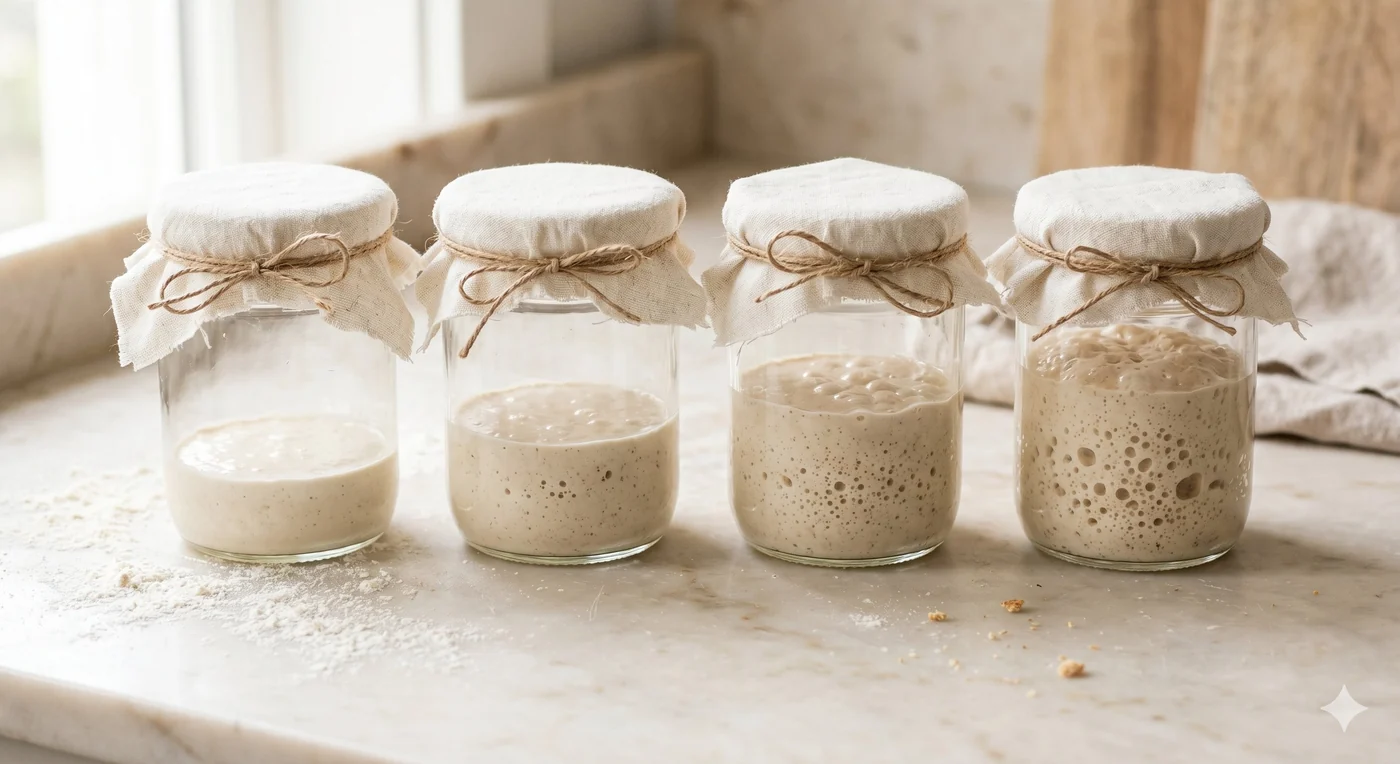
The mother, day by day flat, then bubbling, then alive
Equal parts flour and water. That's the entire recipe. Wild yeast and lactic acid bacteria live on every grain of wheat and in the air of your kitchen, the mother is simply a home you build for them.
Each day you discard half and feed her fresh flour and water. By day three she sighs her first bubbles. By day five she smells of green apples and yogurt. By day seven she doubles in six hours and you know: she's ready to raise bread.
Mix 50g whole wheat flour + 50g water in a clean jar. Cover loosely.
Feed twice daily. Mark her height with a rubber band and watch her climb.
The float test: a spoonful dropped in water floats. She's strong enough to bake.
Stage II
Building the dough
Hours 0 – 12
Stretch & fold strength without kneading
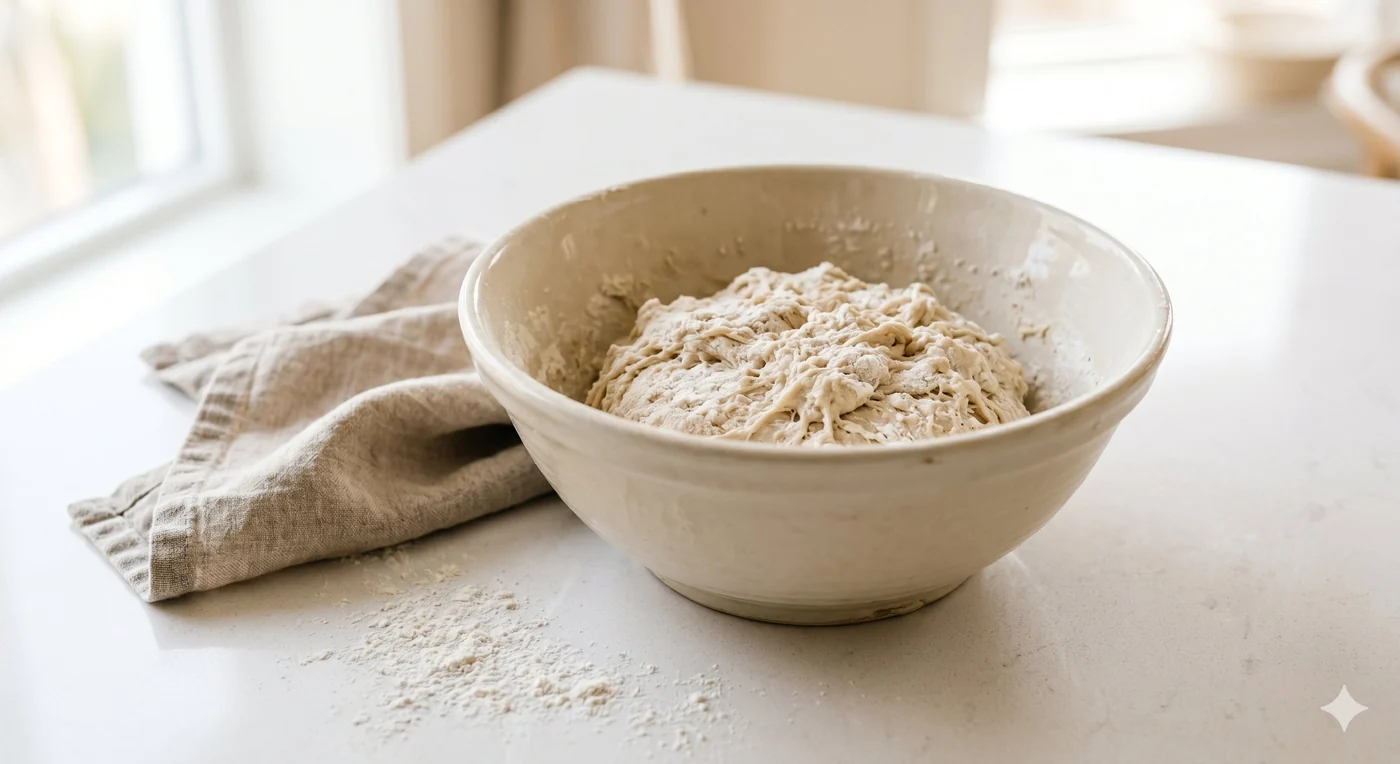
Sourdough is not kneaded. kneading dough by hand or using a machine strengthens the gluten network, that may prevent the weaker wild yeast from expanding. Mix flour, water, salt, and a few spoonfuls of the bubbling mother then let time build the structure for you.
Every half hour, wet your hands, lift one side of the dough high, and fold it over itself. Four folds, four times. Between each set, the dough rests, ferments, and quietly transforms from a shaggy mass into something smooth, glossy, and alive.
Autolyse: flour + water, mix into a shaggy dough and rest alone for an hour. Gluten begins forming itself.
Add the active mother and mix it in, then add the salt. Pinch and squeeze to combine.
Stretch & fold every 30 minutes. Watch the dough turn silken.
Incorporate any additional ingredients and distribute them evenly throughout the dough during the final two stretch-and-folds.
Bulk ferment, then shape, then a cold overnight proof in the fridge.
Stage III
Into the fire
45 minutes at 245°C / 475°F
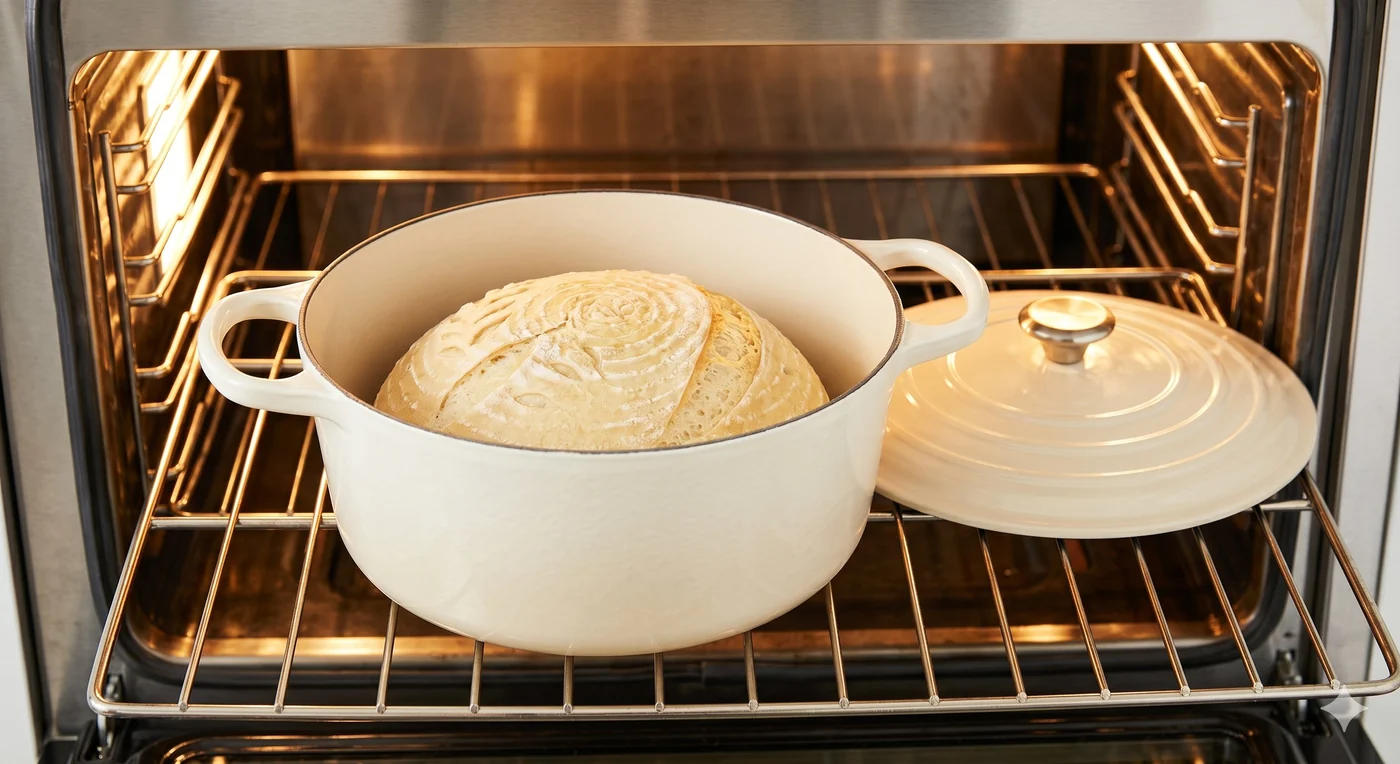
Lid off at minute 25 — when the crust learns its color
The oven spring is the payoff for a week of patience. Cold dough meets a roaring Dutch oven, trapped steam keeps the crust soft for those first crucial minutes — and the loaf leaps upward, splitting along your score line into a proud ear.
Then the lid comes off, and the kitchen changes. The smell of caramelizing crust, this is why people enjoy baking bread.
Preheat the Dutch oven at 245°C / 475°F until it's ferociously hot.
Score the cold loaf in one confident stroke, lower it in.
Steam: mist the dough with water or add a couple of small ice cubes to the Dutch oven, then lid on.
Lid off. Lower the oven to 220°C / 425°F and bake 20 more minutes until the crust is deep mahogany.
Wait. The bread still cooking. Don't cut too early.
Stage IV
The loaf
Worth every hour
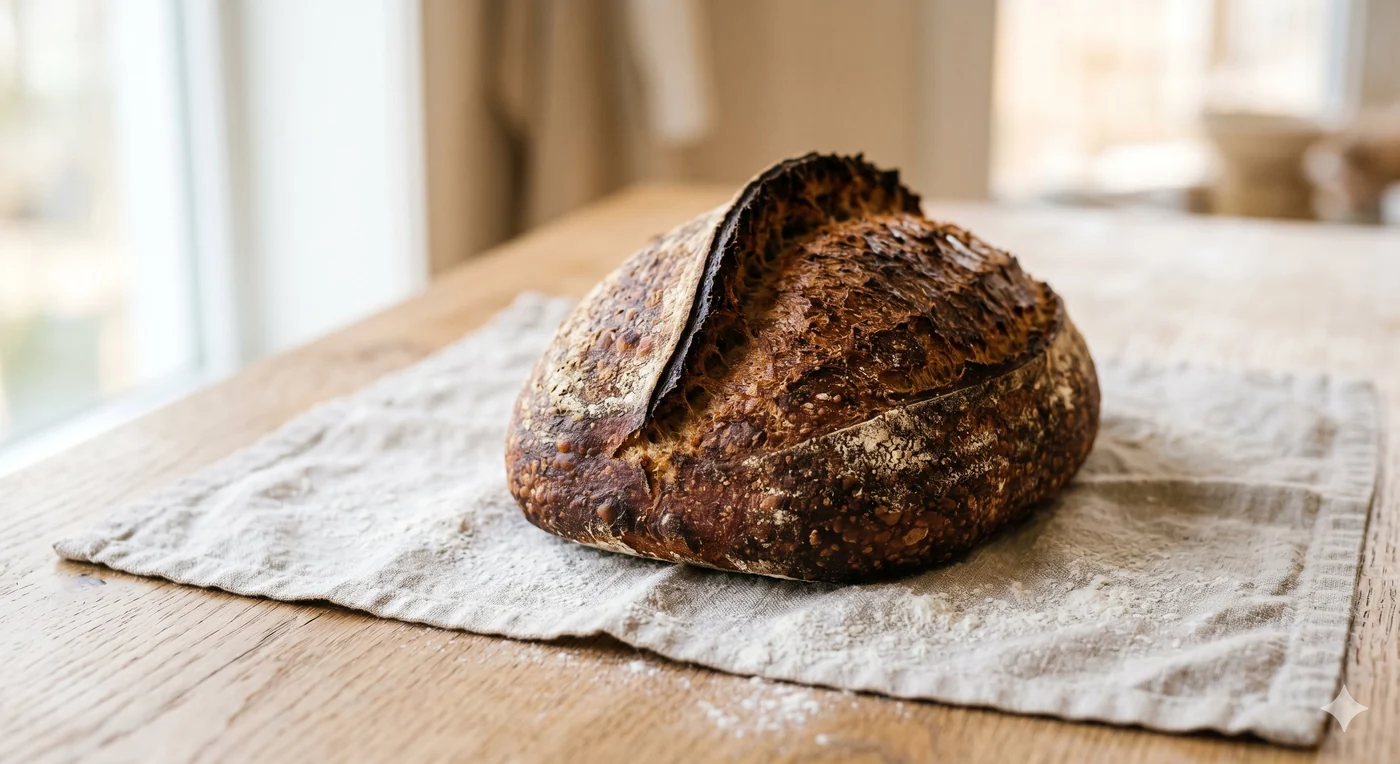
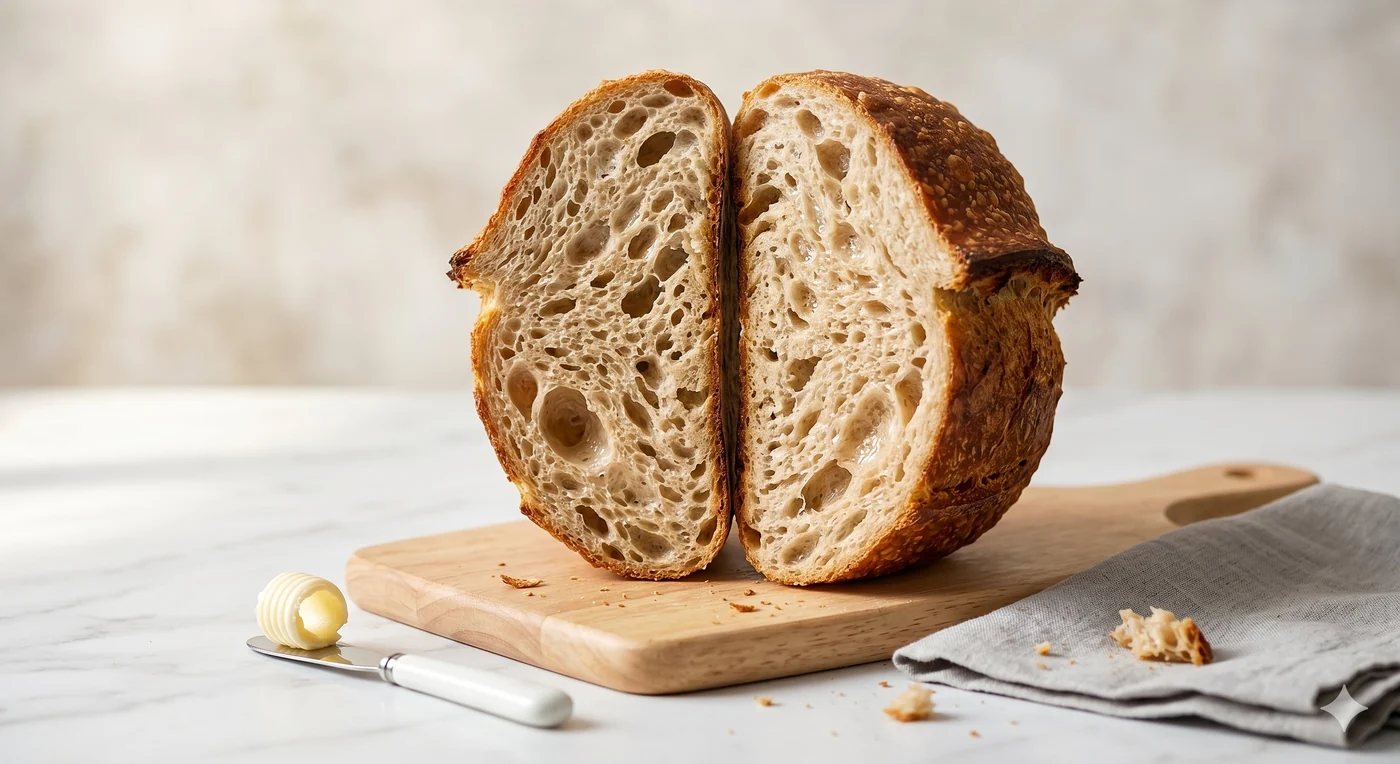
Mahogany crust, singing ear, wild open crumb
Tap the bottom: it should sound hollow, like a drum. The crust shatters; the crumb inside is cream-colored, glossy, and riddled with wild, irregular holes — the fingerprints of fermentation.
The flavor is what no commercial yeast can fake: gentle tang, deep wheat sweetness, a whisper of the week it took to get here. Butter while it's still barely warm. Share it. Then feed the mother again — she's hungry, and there's always a next loaf.
Deep mahogany with blisters, proof of a long cold proof.
A raised ridge along the score, lifted by a oven spring.
Open and glossy, never gummy.
Still in her jar, fed and resting, ready for the next bake. She can live for decades.
The Workbench
Tools of the trade
The baker's math
Set your loaves and hydration, the formula adjusts in real time. Levain is held at 20% and salt at 2% of flour weight, the classic ratios — your starter's own hydration never changes how much of it you use, but it does shift how much fresh flour and water you mix in, so the finished dough always lands at your target hydration.
Bread flour925 g
Water670 g
Active levain185 g
Fine sea salt18 g
Total dough1800 g
70% is the easiest place to begin; 75% is forgiving; 80%+ rewards experienced hands with a wilder crumb.
Feeding the mother
Log each feeding and she'll tell you how she's doing. A mature starter at room temperature likes to eat every 12–24 hours.
No feedings logged yetPress the button after her first meal.
Her diary is empty
0 feedings on record
The baker's weekend
Once the mother is alive, every loaf follows the same gentle rhythm. Here's the full arc, Friday evening to Sunday lunch.
Feed the mother so she peaks overnight.
Autolyse flour and water rest together.
Add mother & salt. Begin stretch & folds.
Shape the boule. Into a banneton, into the fridge.
Preheat the Dutch oven to 245°C / 475°F.
Score, bake, and let it sing on the rack.
First slice, good butter, no regrets.
The Pantry
Eleven variations
Once the plain loaf is second nature, build flavor into it. Fold these in during the final two stretch-and-folds so they distribute evenly without tearing the gluten — except the everything-bagel crust, which goes on the outside.
Rosemary, Roasted Garlic & Parmesan
Rosemary brings piney aromatics, roasted garlic turns sweet and mellow — a world away from raw garlic’s sharpness — and parmesan adds salt and umami. Three different flavor dimensions, so nothing competes.
About 2 tbsp chopped rosemary, 1 head roasted garlic, 100 g grated parmesan.
Fold in
Jalapeño & Sharp Cheddar
The cheese’s fat tames the chili’s heat, and cheddar’s tang plays with sourdough’s own tang rather than clashing — two kinds of acidity layering instead of fighting.
About 2–3 jalapeños, diced, and 150 g sharp cheddar in small cubes.
Fold in
Kalamata Olive, Thyme & Oregano
Briny and herbal — basically focaccia flavors baked into a boule. Salt from the olives amplifies everything else around it.
About 150 g pitted kalamata, halved, with 1 tbsp each thyme and oregano.
Fold in
Toasted Walnut & Dried Fig
Sweet-savory, with great textural contrast between crunchy nut and chewy fruit. A natural cheese-board loaf. Swap figs for dried cranberries if you prefer.
About 100 g toasted walnuts and 100 g dried figs or cranberries, chopped.
Fold in
Everything Bagel
Sesame, poppy, dried garlic and onion, flaky salt. This one’s purely a crust treatment — nothing gets folded into the dough at all.
Brush the shaped loaf with water, then roll or sprinkle the topping on just before scoring.
Crust topping
Pesto, Mozzarella & Parmesan
Herbaceous and rich — pesto swirls through the crumb in ribbons of basil green, while pockets of mozzarella (or nutty parmesan) melt into something close to a savory galette.
About 3–4 tbsp pesto, swirled in during shaping, with 100 g cubed mozzarella or grated parmesan.
Fold in
Kalamata Olive, Feta & Sun-Dried Tomato
Mediterranean, briny, and bold — three salty, acidic ingredients pointing the same direction instead of competing. Pat everything dry first; loose oil and brine will loosen the gluten.
About 120–150 g total of kalamata olives, crumbled feta, and sun-dried tomato, well-drained.
Fold in
Caramelized Onion & Smoked Gouda
Sweet, smoky, and deeply comforting — slow-cooked onions turn jammy and mellow, and smoked gouda melts into little pockets of savory depth. Let the onions cool fully before folding them in.
About 1 large onion, caramelized and cooled, with 120 g smoked gouda, diced.
Fold in
Double Chocolate & Espresso
A rich, cake-like aroma with a chewy artisan crust — cocoa deepens the crumb's color, espresso sharpens the chocolate, and every chunk stays a gooey pocket after baking.
Replace about 10% of your flour weight with dark cocoa, bloomed in part of your water or brewed coffee, plus 100 g dark chocolate chunks.
Fold in
Cinnamon, Pecan & Dried Cranberry
The ultimate breakfast toast loaf — warm cinnamon, toasted pecan crunch, and plump cranberries in every slice. Soak the cranberries first so they don't pull moisture out of the dough.
About 1 tsp ground cinnamon, 80 g toasted pecans, and 80 g dried cranberries, soaked and drained.
Fold in
Lemon Zest & Dried Blueberry
Bright, summery, and slightly sweet — lemon zest steeped into the dough water perfumes the whole loaf, and dried blueberries stay plump and jammy through the bake.
Zest of 1–2 lemons added to the dough water, with 100 g dried blueberries folded in at the last stretch-and-fold.
Fold in
Pro tips for adding mix-ins
When to add Fold inclusions in during your final one or two stretch-and-folds. Too early tears the gluten strands while they're still developing; too late makes them hard to distribute evenly.
Watch the hydration Wet items — fresh berries, pickled peppers, oily sun-dried tomatoes — add moisture and can make the dough sticky. Dry items like walnuts or seeds absorb water and dry it out. Adjust your base recipe's water by 2–5% depending on what you choose.
The 20% rule As a baker's guideline, keep total mix-ins to around 15–20% of your total flour weight — for a loaf with 500 g flour, that's roughly 75–100 g of added ingredients.